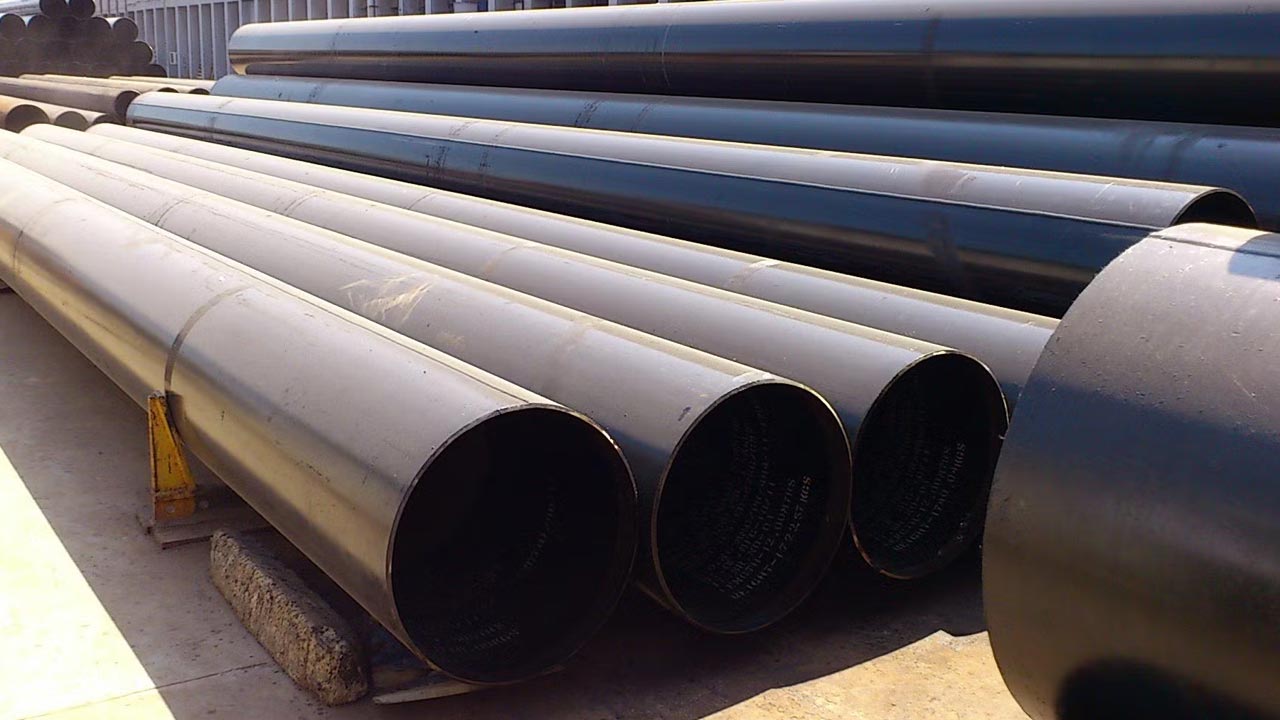
Carbon Steel Pipes
Carbon steel pipes are widely used in various industries due to their strength, durability, and cost-effectiveness. Made primarily from iron and carbon, these pipes offer excellent mechanical properties and resistance to wear and tear. They are commonly utilized in construction, oil and gas, water transportation, and industrial applications for conveying fluids and gases. Carbon steel pipes come in different grades and thicknesses to suit specific requirements, and they can be manufactured through seamless or welded processes. Their ability to withstand high pressure and temperature conditions makes them ideal for pipelines, structural purposes, and machinery. Additionally, carbon steel pipes can be treated with coatings or corrosion-resistant layers to enhance their longevity in harsh environments.
Carbon Steel Pipes - Specifications
| Parameter | Description / Options |
|---|---|
| Standards |
ASTM A53, ASTM A106, ASTM A333, ASTM A335, ASTM A179, ASTM A210, API 5L, ASME B36.10M, EN 10216-1, EN 10217-1, JIS G3452 |
| Grades |
ASTM A53 Grade A / B, ASTM A106 Grade A / B / C, API 5L Grade B, X42, X46, X52, X56, X60, X65, X70, X80, ASTM A333 Grade 1 / 6 (Low Temp), ASTM A335 P1-P91 (Alloy grades used with carbon steel pipes for high-temp) |
| Pipe Types | Seamless (SMLS), Welded (ERW - Electric Resistance Welded, SAW - Submerged Arc Welded) |
| Outside Diameter (OD) | 6 mm (1/8") up to 1219 mm (48") and higher depending on standard |
| Wall Thickness | Schedule 5, 10, 20, 40, 80, 160, XXS (as per ASME B36.10M / B36.19M) |
| Length | Random (5-7 meters), Fixed (up to 12 meters), Custom lengths available |
| End Types | Plain End (PE), Beveled End (BE), Threaded (NPT / BSP) |
| Surface Finish | Black, Galvanized, Painted, Mill Finish, Coated (Corrosion Resistant) |
| Chemical Composition (Typical) |
Carbon (C): 0.10 - 0.30%, Manganese (Mn): 0.30 - 1.20%, Phosphorus (P): ≤ 0.04%, Sulfur (S): ≤ 0.05%, Silicon (Si): 0.10 - 0.35% |
| Mechanical Properties (ASTM A106 Grade B) |
Tensile Strength: 415 - 550 MPa, Yield Strength: ≥ 240 MPa, Elongation: ≥ 30% (in 2 inches) |
| Pressure Rating | Varies by schedule and temperature; governed by ASME B31.1 / B31.3 standards |
| Testing Methods | Hydrostatic Test, Ultrasonic Testing (UT), Radiographic Testing (RT), PMI (Positive Material Identification) |
| Certification | EN 10204 3.1 / 3.2 Mill Test Certificate (MTC), ASTM MTC, API Certification |
| Typical Applications |
Oil & Gas Pipelines, Water & Steam Transmission, Boilers, Heat Exchangers, Structural & Mechanical Applications, Chemical Processing Plants |
Mechanical Properties
| Grade | Tensile Strength (MPa) | Yield Strength (MPa) | Elongation (%) | Hardness (HB) |
|---|---|---|---|---|
| A106 Gr.B | 415 - 550 | ≥ 240 | ≥ 30 | 120 - 180 |
| API 5L Gr.B | 415 - 535 | ≥ 241 | ≥ 30 | 120 - 180 |
| ASTM A53 Gr.B | 415 - 540 | ≥ 240 | ≥ 30 | 120 - 180 |
| 304 (Stainless Steel) | 520 - 750 | 205 - 310 | 40 - 60 | 70 - 90 |
| 316 (Stainless Steel) | 515 - 690 | 205 - 275 | 40 - 60 | 70 - 90 |
| Carbon Steel A234 WPB | 415 - 550 | ≥ 240 | ≥ 30 | 120 - 180 |
Chemical Composition
| Grade | C (max %) | Mn (max %) | Si (max %) | P (max %) | S (max %) | Other Elements |
|---|---|---|---|---|---|---|
| A106 Gr.B | 0.30 | 1.00 - 1.35 | 0.10 - 0.35 | 0.035 | 0.035 | — |
| API 5L Gr.B | 0.26 | 1.35 - 1.65 | 0.10 - 0.35 | 0.035 | 0.035 | — |
| ASTM A53 Gr.B | 0.30 | 1.20 - 1.50 | 0.10 - 0.35 | 0.05 | 0.05 | — |
| 304 (Stainless Steel) | 0.08 | 2.00 | 1.00 | 0.045 | 0.030 | Cr 18.0–20.0%, Ni 8.0–10.5% |
| 316 (Stainless Steel) | 0.08 | 2.00 | 1.00 | 0.045 | 0.030 | Cr 16.0–18.0%, Ni 10.0–14.0%, Mo 2.0–3.0% |
| Carbon Steel A234 WPB | 0.30 | 1.00 - 1.35 | 0.10 - 0.35 | 0.035 | 0.035 | — |